Showing posts with label project butterfly. Show all posts

Monday, April 22, 2013

Happy Earth Day: Planting our Milkweed seeds

For Earth day we are sharing our progress in our 'Save the Monarch' Project. For the original post about our plans click on here or on the picture.

This past weekend we planted all our Tropical Milkweed seeds. Thank to the inspiration from Organic Aspirations we planted them all in mini 'greenhouses' made from plastic berry containers. The kids had a fun evening scooping and raking dirt.

Here is our little nursery of 100 Pink Tropical Milkweed seedlings.

We already fully grown plants waiting for the Monarchs because these seeds won't be ready for hungry caterpillars for at least 45 days. We ordered the plants from Educational Science. They arrived very quickly and were nice and strong.
  Even Perry was satisfied with the packaging....
They have a nice sunny spot and are just beginning to flower.

So long as the sunny spring days continue, we should have lots of strong seedlings to feed the caterpillars. There should also be plenty left over to re-pot and give to our neighbors. As Miss K pointed out, by doing this, even if we move before next spring the Monarchs will still be able to visit our neighbors' plants.

We have been reading a lot since we started this project and as we were about to plant the seeds we read something that made us have second thoughts...

In March Texas Butterfly Ranch posted about the efforts of the Native American Seed Company to restore Native milkweed.

'Gardeners and butterfly fans committed in theory to propagating and planting native milkweeds (and I consider myself among them) have been vexed in practice by their persnickety ways.   That’s what often drives us to plant Tropical Milkweed, the nonnative Asclepias curassavica that is easy-to-grow, widely available and the favorite of Monarch butterflies for hosting and other butterflies for nectar. While the practice bothers some scientists and native plant purists, our rationale is that Monarch caterpillars need to eat.   In short, it’s better to provide SOME host plant for migrating Monarchs than NONE as they pass through Texas.' Source

 We decided to check the nearby parks and green belts for Native Milkweed. We have yet to find any. Talking with the locals it seems that a lot of the area has been cleared for new Houses, Apartments and Retail expansion. We felt, like Texas Butterfly ranch, that the Monarchs will need something in in our part of Texas even if (for the present) all we have to offer is the tropical variety.

Source
We are going to spend some weekends a bit further from home looking for Native milkweed to collect seeds from. However it looks like this could be easier said than done....
Persnickety Texas Milkweeds may not lend themselves to Mass Seed Production

We also intend to contact our local council about the issue of Milkweed depletion.

How is the Native Milkweed doing in your area? If you need some help, to identify the native milkweed in your State, the University of Minnesota has some good resources here.

Tuesday, April 9, 2013

A great Earth 'day' project: Save the Monarchs!

Source

We had been planning a unit on recycling to celebrate earth day this year. That, was until I recently I read an article about the decline in Monarch Butterfly numbers.

We love Butterflies and I couldn't imagine not seeing Monarch's in our gardens or at the park in the Summer!

Butterflies were also the reason we began this blog nearly two years ago. For Easter 2011 the Piwis received a butterfly garden. The blog was a way to show family how our painted lady caterpillars were growing. Each day Miss K would type a few words into the title of the post and I would add a picture. Eventually we released the butterflies in the Community gardens.

I showed Miss K the article about the Monarchs and she asked how we could help.

To get a better idea of the reasons for the decline we visited Monarch watch. MW is a group that  monitor the numbers of Monarch and their amazing Migration. They have also begun a program to help gardeners set up 'way stations' for the butterflies.

We have learnt so far that the Monarch Host plants (Milkweed) are less abundant. There are apparently multiple environmental and social reasons for this. Thankfully there is still hope: Chip Taylor (Monarch Watch Director) summarizes the situation:

"All in all, it was not a good year for monarchs. While some of the present decline can certainly be attributed to the seasonal conditions last summer, it is the decline of monarch habitats in the United States and Mexico that is the major concern. The good news is that we can do something about the habitats in the United States and Canada – we can plant milkweed. That said, in order to compensate for the continued loss of habitat we need to plant LOTS AND LOTS of milkweed. To assure a future for monarchs, conservation and restoration of milkweeds needs to become a national priority." (source).

With a bit of planning we came up with:

The Piwi Kids 'Save the Monarch Plan'

Research:

  • Produce a Lap book that will outline everything we learn about:
  • The Monarch lifecycle and Migration
  • Native milkweed vs. Tropical Milkweed
  • The causes of the decline in Monarch numbers
  • The causes of decline in host plants.

Projects:

  • Purchase fully grown Milkweed plants. These are on their way  have arrived from Educational Science.
  • Look into the possibility of  hosting a way station and encourage people and public gardens in our community to also host them.
  • Propagate Milkweed Plants from seeds to give to gardeners in our community. You can find these at Live monarch.com  for a small donation. We are waiting for ours to arrive.
  • Make lots of Butterfly crafts!

Field trips: 

  • Visit local community gardens to observe butterflies and identify host plants
  • Visit a Butterfly sanctuary
  • View 'Flight of the butterflies'

To date we have ordered our Milk weed plants and seeds. Next week we begin our research for the lap book. Should be a lot of fun and learning!

I will be pinning resources for this project on our Pinterest board:


What plans do you have for Earth day?


Monday, October 29, 2012

C is for Caterpillar

Mini Piwi is 34.5 months old
Miss K used pom poms and squinkies to dot these pictures. See end of the post for the material links
After a week of Space fun we were back to our letters. This week was supposed to be C for Caterpillar.

However, it is kind of hard to have Caterpillars without butterflies so we used the left over activities from the letter B week. This worked out well since we were planning on seeing visiting the Cockrell butterfly house.
 
 Mini Piwi played memory with her Caterpillar cards a lot! sometimes you were even allowed to take a turn too

I had covered the front and back of the the folder with clear book covering so Mini Piwi could use the awesome Crayola dry erase crayons we finally replaced last week. FYI, do not leave them in your handbag and put said Handbag on the seat of the car in full sunlight -these crayons melt even faster than regular crayons.The tracing activities were a hit as expected as she loves anything that looks like her big sister's handwriting. What did surprise me is that she took an instant dislike to the size sorting butterflies and refused to have anything to do with it. Oh well, never can tell...

On rainy Wednesday we visited the butterfly house, with Mini Piwi insisting on being out guide...

Her favorite was the blue Morpho that we saw on Diego
We even got to see the chrysalis and cocoons in the special hatching room. Mini Piwi shouted a hi to the caterpillars busy at their metamorphoses (not too sure at the plural of this one)

On Friday we finished up the week with a hungry little caterpillar craft from Reading confetti. It is such a cute idea. You make the caterpillar from egg cartons....we used oil pastels to color ours as our paints are 300 miles away.
Reading confetti has a printable of all the food the hungry little caterpillar ate (an apple, two pairs, etc). Mini Piwi cut one out and then delegated the rest Miss K. We then retold the story -I did
n't even need to grab the book cause Miss K know it by heart. Mini Piwi counted out each food.
 This went really well until we came to the part where he goes into a cocoon (spoiler alert). This led us to rummage through the recycling bin to find a suitable cocoon, and then make a 'costume' for a toy caterpillar we have so he could be the butterfly. Miss K decided they could turn it into a puppet show if we also made a scene where the egg is first is laying on the leaf. This is what we ended up with...
Making the first scene
The puppet show ready to go

Putting on the show...'scuse the recycling and sandals
Links to materials we used this week
Butterfly unit from Two teaching mommies
Feed the Hungry Caterpillar craft from reading confetti
Preschool Pack Pretty Bugs from 1+1+1=1
Cockrell Butterfly Center @ Houston Museum of Nature and Science

Monday, May 9, 2011

Day 7. All the Caterpillars are in a Cocoon.

One made his cocoon on the side

4 are hanging from the top.

If you look close you can see their little legs

Thursday, May 5, 2011

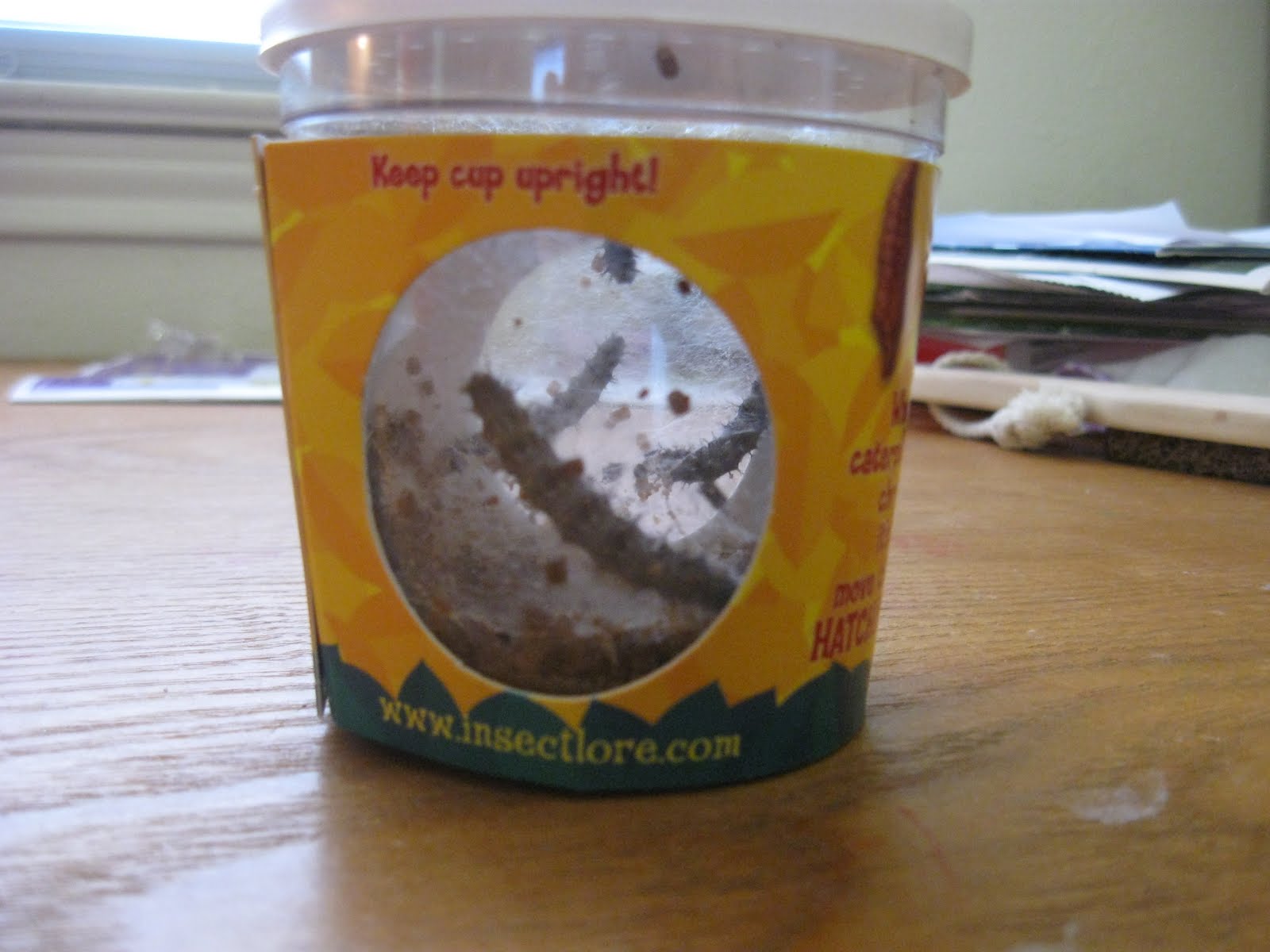
Day 3. They are getting bigger.

The biggest one is 35mm. They are black and hairy with white feet.

Sunday, May 1, 2011

Project Caterpillar


For Easter the Piwi's recieved a butterfly hatching kit. This year they had studied lifecycles in Science so it will be a great opportunity to watch it happening. The kit is from Insect Lore and $14.99 on Amazon.
The kit comes with a certificate for 5 caterpillars which a shipped from Insect lore in 1-2 weeks. We opted to order online rather than by mail. Now we are just waiting for the little creepy crawlies.
 

About